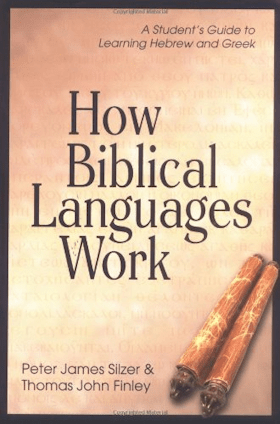
Silzer and Finley’s (2004) How Biblical Languages Work represents a striking case in terms of how the field of linguistics has had an impact upon the study of Greek and Hebrew. Ostensibly, the book is an introduction to basic linguistics concepts specifically designed for biblical language students. They present common tools and concepts of grammatical analysis from applied linguistics but tailored for biblical languages. The book fills a substantial need, yet never saw widespread adoption. The mixed reviews it received are revealing. Many reviewers praised the concept of introducing linguistics, while also demurring that much of that same content was too advanced (e.g. Gupta 2004, Rogland 2005, Brug 2006).
This seems a consequence of how interdisciplinary work functions: The biblical language teaching infrastructure is built centrally for interpretation, while language analysis gets treated as an advanced topic. As a result, education linguists consider undergraduate material becomes graduate or doctoral level. If a Bible student wants to pursue Greek or Hebrew linguistics studies, they go to specific universities for graduate school that specialize in Greek or Hebrew. But without the broader education provided by a regular linguistics department, this occasionally results in some scholars working in Greek or Hebrew linguistics not realizing where their knowledge gaps are.
This state-of-affairs has existed for too many decades now. While it has produced some impressive work, the vast majority of it resides in expensive monographs and fails to be integrated into pedagogical resources. The exception that proves the rule would be something like Runge (2010), which legitimately brought many important linguistic concepts into Greek classrooms in a way other textbooks have not. But on the whole, there is a reason survey books like Noonan (2020) and Campbell (2015) are so successful: they provide a map for students in second or third year exegesis or advanced grammar courses to navigate a world of biblical language linguistic publications that their teaching grammars have failed to prepare them for.
For the most part, change in moving forward the linguistic study of the biblical languages is primarily defined by the efforts of individual teachers at the scale of their individual classrooms. And yet, there is clearly demand for more integrated education of linguistics and biblical languages together, evinced by the success Glossa House which focuses nearly entirely on biblical languages. We hope that developments such as these are part of a larger snowball effect upon the teaching of Greek and Hebrew more broadly.
Works cited
Brug, John F. 2006. “Review of How Biblical Languages Work, by Peter J. Silzer and Thomas J. Finley,” Wisconsin Lutheran Quarterly 103.
Campbell, Constantine. 2015. Advances in the Study of Greek: New Insights for Reading the New Testament. Grand Rapids, MI: Baker Academic.
Gupta, Nijay. 2004. “Review of How Biblical Languages Work: A Student’s Guide to Learning Hebrew and Greek by Silzer, Peter James and Thomas John Finley,” Review of Biblical Literature.
Noonan, Benjamin. 2020. Advances in the Study of Biblical Hebrew and Aramaic: New Insights for Reading the Old Testament. Grand Rapids, MI: Baker Academic.
Rogland, Max. 2005. “Review of How Biblical Languages Work: A Student’s Guide to Learning Hebrew and Greek by Silzer, Peter James, and Thomas John Finley,” Review of Biblical Literature.
Runge, Steven E. 2010. Discourse Grammar of the Greek New Testament: A Practical Introduction for Teaching and Exegesis. Peabody, MA: Hendrickson.
 Koine-Greek