Prepositional phrases are one of the larger understudied and ignored elements of traditional biblical language grammar education. In large part, the grammars pass the question to the dictionaries, which in turn attempt to pass them back to the grammarian again. Both grammars and dictionaries default to simple translation glosses presented in lists. For example, here is the skeleton of BDAG’s entry for ἐν:
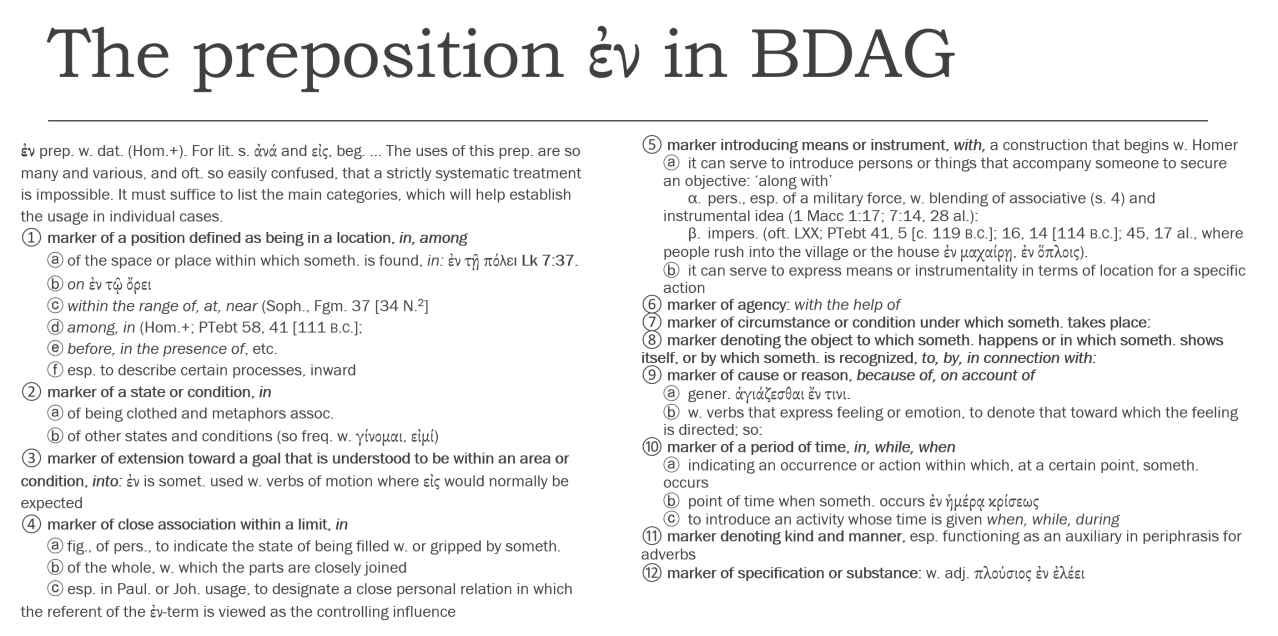
Because of the space constraints of dictionaries, little to no guidance is provided for understanding how these senses relate to each other and students, pastors, scholars, and translators often end up simply picking and choosing as if these senses functioned as a sort of menu of equally valid options. How in the world does a student know when to choose #6: “marker of agency: with the help of“?
Spatial diagrams in grammars provide little additional help. They provide no guidance for how abstract senses relate to spatial ones. Moreover neither of these approaches provide any insight into the more complex syntactic patterns that prepositional phrases participate in. One of those syntactic patterns involves the SOURCE-PATH-GOAL construction: two prepositional phrases, one marking SOURCE and one marking GOAL, that function together in a single clause. We have recorded below our SBL23 paper on these constructions with the hope that it will be useful not just for our work in Bible translation, but also students, pastors, and scholars.
Split into a two part video series, we examine how cognitive linguistics can provide insight into the meaning of a specific family of prepositional constructions: “A certain man went down from Jerusalem [SOURCE] to Jericho [GOAL]” (Luke 10:30). In the first video, we discuss relevant grammatical concepts and introduce the construction with a few of its metaphorical extensions. In the second part, which will be available tomorrow, we survey the rest of the Source-Path-Goal construction types with their structure and meaning. We conclude with a discussion of some specific examples that translators and interpreters have historically struggled with and a summary of the grammar.
We hope you all benefit from this new work. Producing video content is a wholly new endeavor for us. Any feedback or encouragement would be appreciated.
Our work on Greek grammar for Bible translation is funded by people like you. We generally avoid direct requests for support, but today, Giving Tuesday, perhaps consider contributing to our work with Wycliffe Bible translators:
 Koine-Greek