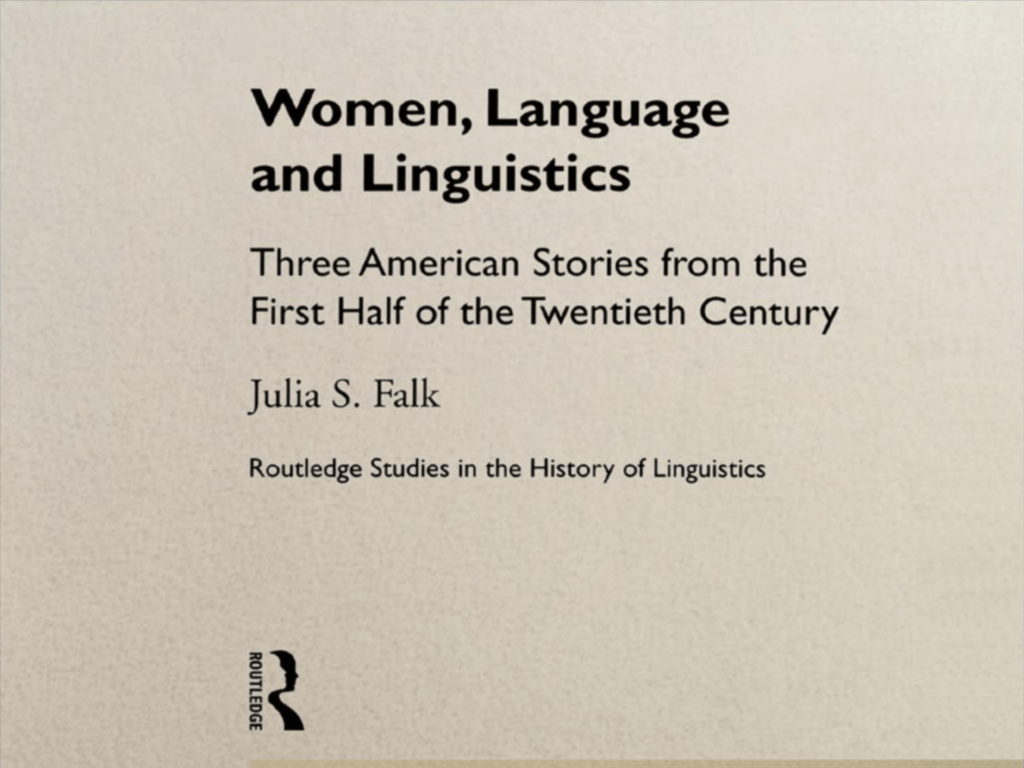
Over the past year, I’ve been off-and-on reading Julia Falk’s Women, Language and Linguistics: Three American Stories from the First Half of the Twentieth Century. It’s a superb book, but also reflect substantial tragedy in terms of how women’s scholarship is neglected in standard modes of historiography. This book shines a light on those failures and then also makes a contribution that helps rectify some of them when it comes to women in American linguistics in the first half of the 20th century—particularly with regard to the Linguistics Society of America (LSA).
The founding of the LSA was surprisingly equal in many ways—it not only called on senior professors to join, but in fact, all “students of language … to meet each other, give … opportunity for the exchange of ideas, and represent the interests of our studies” (Language 1:1.6–7[1 925]). Indeed, as Falk notes (1999, 6), the invitation to membership was put out to both men and women explicitly:
“Membership in the Society is not restricted to professed scholars in linguistics. All persons, whether men or women, who are in sympathy with the objects of the Society, are invited to give it their assistance in furthering its
work” (LSA Bulletin 2.2[1928]).
This invitation seemed promising of something new and positive in scholarship, yet fairly quickly existing academic barriers reasserted themselves. Falk says that roughly 10–15% of LSA membership in the first decade was women and there were 31 female founding members of the LSA.
Many had earned doctoral degrees at prestigious institutions and held professorships. Some published their dissertations and other scholarly works, served within the professional organizations, and spoke at the conferences of learned societies (Falk 1999, 7).
But soon after, women and their scholarship receded within the membership of the LSA. By 1945, there were only seven women remaining. Practically speaking, this happened because of the fundamental lack of opportunity for women in linguistics (and the academy generally) in these first decades of the twentieth century. There were no professorships at prestigious schools for women regardless of their education. There were no titles, no chairs, or labs. And most of the women who initially joined the LSA ended up as high school teachers and lost their ability to engage with their academic peers. The women who had positions at small women’s colleges also struggled to continue their participation.
One of the few women who continued within the LSA beyond 1945 was Edith Claflin. She is not a central participant in Falk’s book, but Falk takes some time to highlight her and her work in the first three chapters (I’m working on finding a copy of Falk’s fuller account of Claflin in Falk 1995).
But Claflin is center stage here because I already recognized her name as I was reading and I appreciated the way Falk fleshed out this scholar whose work had already influenced mine. Claflin was an important contributor to the linguistics of Ancient Greek. Her PhD was a syntax of epigraphic inscriptions: “The syntax of the Boetian dialect inscriptions.” But as a woman, there were limits to what professorships were available to her, so instead she taught high school in the Midwest. With the LSA, her research was regarded as mere “historical linguistics” and “philology” by her male linguistic peers (Falk 1999, 16). Between the teaching burdens of grade school and her distance from academic centers of influence on the US East Coast, her academic output shrank. And it wasn’t until much later in her career that she began publishing again. After her dissertation (defended 1904; published 1905), she published nothing more for over 20 years. It was only when she was back on the East Coast again and was able to attend LSA meetings starting in 1925 that Claflin continued her research. And then she produced some profoundly insightful work on Greek (and Indo-European) aspect and voice.
And yet, despite what should have been viewed as ground-breaking insights into the Greek and Latin verbal systems, her citations are minimal on Google Scholar (which, while I understand is not necessarily the best gauge is one of the few gauges we have).
Her work also intersected with mine on the Greek perfect. In my chapter in Merkle & Black (2020), I cite her for the middle-only nature of high transitivity verbs in the perfect. Notably, here, Willi, who I also cite, has no bibliographic references to her work at all in his 750 pages on the IE verb.

And you’re not likely to find her work cited in any of the major publications on Greek aspect, either—certainly none of the ones on New Testament Greek. But her work is worth reading and I would encourage all of you to dig in and discover what new (old) insights you can glean from her mind, albeit now nearly 100 years late.
Claflin, Edith F. 1905. The Syntax of the Boeotian Dialect Inscriptions. (Bryn Mawr College Monograph.) Baltimore, MD: The Lord Baltimore Press.
Claflin, Edith F. 1927. The nature of the Latin passive in the light of recent discoveries. The American Journal of Philology 48.2: 157-175. (pdf)
Claflin, Edith F. 1929. The Hypothesis of the Italo-Celtic Impersonal Passive in r. Language 5: 232 250. (pdf)
Claflin, Edith F. 1936. Venetic tolar, Old Irish canar, and the Indo-European Injunctive. Language 12: 23–34.
Claflin, Edith F. 1938. The Indo-European Middle Ending r. Language 14: 1–9.
Claflin, Edith F. 1939. The Voice of the Indo-European Perfect. Language 15: 155–159.
Claflin, Edith F. 1942. The Middle Verb videri. Language 18: 26–32.
Claflin, Edith Frances. “Videor as a deponent in Plautus.” The American Journal of Philology 64, no. 1 (1943): 71-79.
Claflin, Edith F. 1946. The middle voice in the De Senectute. The American Journal of Philology 67.3: 193-221.
I highlight these, but she also published a number of articles on language teaching and pedagogy, that might be of interest to those teaching Greek (or Latin) today.
And I would certainly also encourage you to pick up a copy of Julia Falk’s book, as well:
Falk, Julia S. Women, language and linguistics: Three American stories from the first half of the twentieth century. Routledge, 2002.
Other works cited:
Aubrey, Michael. 2020. “The Greek perfect tense.” Edited by David A. Black and Benjamin K. Merkle. Linguistics and New Testament Greek: Key Issues in the Current Debate, 55–81. Grand Rapids, MI: Baker Academic.
Falk, Julia S. 1995. “Portraits of women linguists: Louise Pound, Edith Claflin, Adelaide Hahn.” Edited by: Kurt R. Jankowsky. History of Linguistics 1993: Papers from the Sixth International Conference on the History of the Language Sciences (ICHoLS VI), Washington DC, 9–14 August 1993, 313-320. John Benjamins Publishing Company.
Willi, Andreas. 2018. Origins of the Greek verb. Cambridge University Press.
Black, David Alan, and Benjamin L. Merkle, eds. 2020. Linguistics and New Testament Greek: Key issues in the current debate. Baker Academic.
 Koine-Greek