Nearly all major English translations in Acts 9:36 completely fail to communicate what the author of Acts is trying to do here: tell his readers that the name ‘Tabitha’ is a Aramaic word (טַבְיְתָא) that means ‘gazelle’. Luke’s audiences doesn’t want to know that two names correspond in an unknown way. Luke’s audience wants to know the meaning of Tabitha, so he gives them the Greek word for ‘gazella’: δορκάς.
| CSB In Joppa there was a disciple named Tabitha (which is translated Dorcas). She was always doing good works and acts of charity. |
| ESV Now there was in Joppa a disciple named Tabitha, which, translated, means Dorcas. She was full of good works and acts of charity. |
| HCSB In Joppa there was a disciple named Tabitha, which is translated Dorcas. She was always doing good works and acts of charity. |
| LEB Now in Joppa there was a certain female disciple named Tabitha (which translated means “Dorcas”). She was full of good deeds and charitable giving which she was constantly doing. |
| NASB Now in Joppa there was a certain disciple named Tabitha (which translated in Greek is called Dorcas); this woman was abounding with deeds of kindness and charity, which she continually did. |
| NIV In Joppa there was a disciple named Tabitha (in Greek her name is Dorcas); she was always doing good and helping the poor. |
| NIV84 In Joppa there was a disciple named Tabitha (which, when translated, is Dorcas), who was always doing good and helping the poor. |
| NASB95 Now in Joppa there was a disciple named Tabitha (which translated in Greek is called Dorcas); this woman was abounding with deeds of kindness and charity which she continually did. |
| NLT There was a believer in Joppa named Tabitha (which in Greek is Dorcas). She was always doing kind things for others and helping the poor. |
| NRSV Now in Joppa there was a disciple whose name was Tabitha, which in Greek is Dorcas. She was devoted to good works and acts of charity. |
But English translation teams seem more interested in transliterating a Hebrew word and in turn transliterating a Greek word rather than telling the reader what that word means, which is certainly what Luke intended for his own readers: ‘antelope, gazelle’ (in Asia Minor and Africa) and ‘deer’ in Greece.
‘Gazelle’ is often placed in a footnote at the bottom of the page. This is better than nothing. But it raises the question: “Why would you relegate authorial intent to a footnote?”
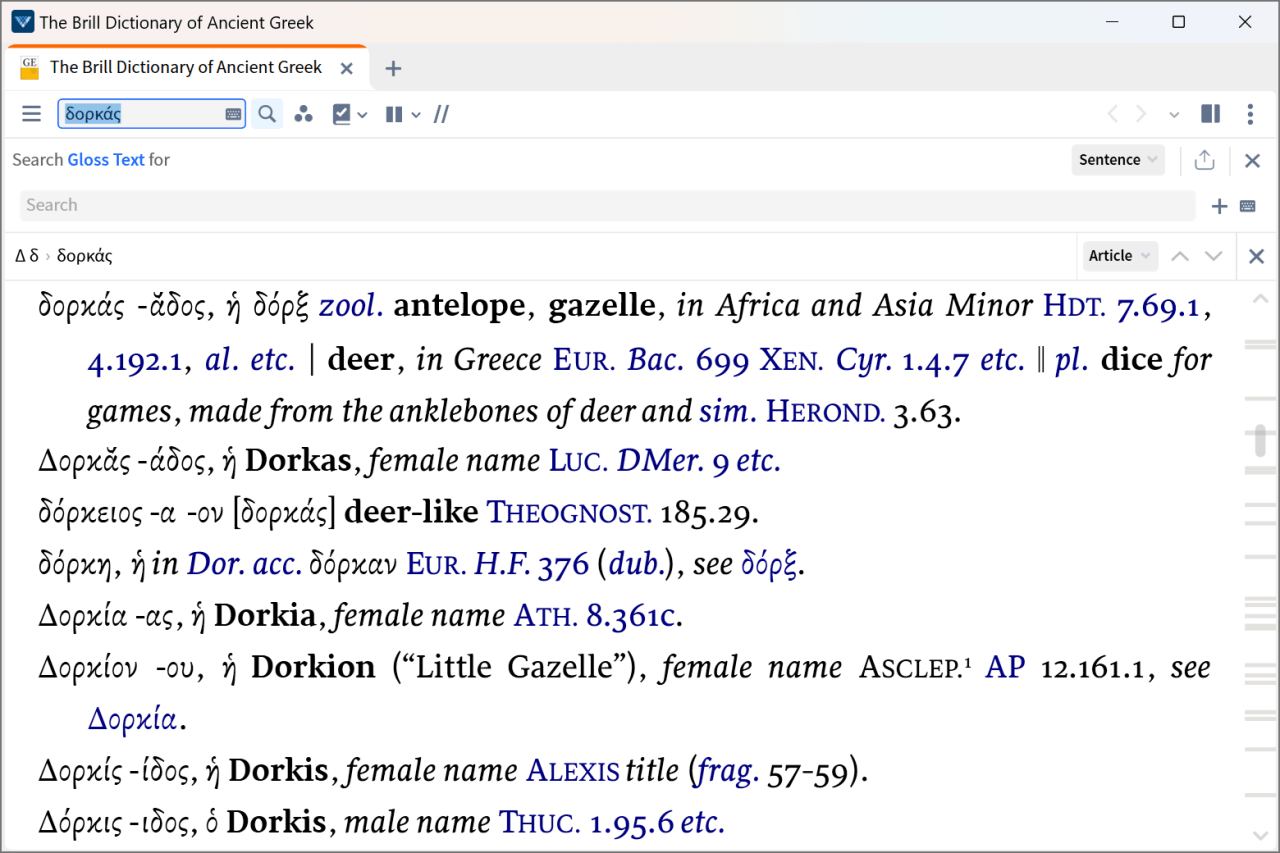
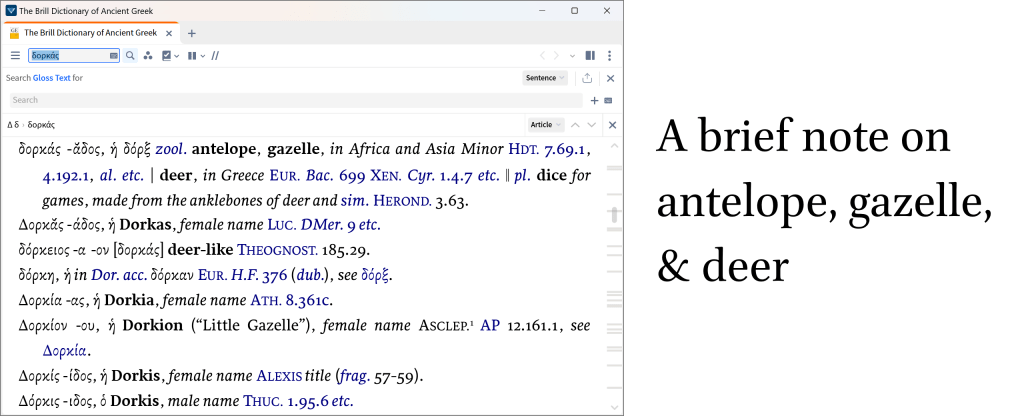
δορκάς -ᾰ́δος, ἡ δόρξ zool. antelope, gazelle, in Africa and Asia Minor HDT. 7.69.1, 4.192.1, al. etc. | deer, in Greece EUR. Bac. 699 XEN. Cyr. 1.4.7 etc. ‖ pl. dice for games, made from the anklebones of deer and sim. HEROND. 3.63.
—G-E (Montanari, Goh, & Schroeder 2015).
A Bible translation colleague recently dealt with this on language project. So this indigenous language now has a translation of Acts 9:36 that’s more accurate than major English translations.
 Koine-Greek