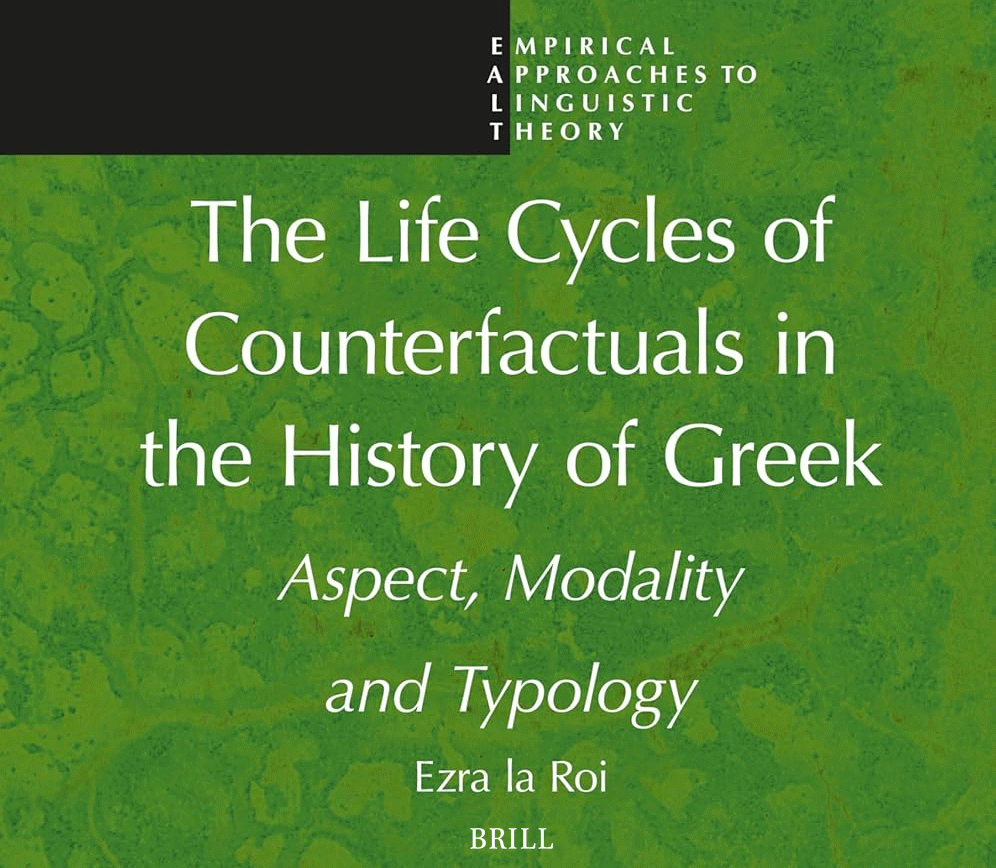
Ezra la Roi‘s work on various domains of modality (conditionals, insubordination, counterfactuals, and more) in Ancient Greek has been pretty prolific over the past number of years and it is exciting to see his new monograph, The Life Cycles of Counterfactuals in the History of Greek published this past November (2025)—not the least because I am also currently reading Leonard Talmy’s (2021) The Life Cycle of Adpositions, which is also about diachronic change in Ancient Greek. I’ve already added the book to my reading list for 2026 and would encourage any of our readers here who are interested in: historical linguistics, Ancient Greek, or language change to pick it up and read!
Thank you, Ezra, for what looks to be an excellent contribution in advancing the study of Ancient Greek within linguistics and language typology!
Title: The Life Cycles of Counterfactuals in the history of Greek: Aspect, Modality, and Typology (Amazon) by Ezra la Roi
Product details
- Publisher: Brill
- Publication date: November 27, 2025
- Language: English
- Page Count: 344 pages
- ISBN-13: 978-9004749924
- Dimensions: 6.1 x 0.81 x 9.25 inches
Publisher’s description
We constantly refer to counterfactual events–things that didn’t happen but could have–through conditional, wish, and modal constructions. Yet, despite their ubiquity, we still know surprisingly little about how these constructions have evolved across languages and through history. This book breaks new ground by tracing, for the first time, the development of counterfactual systems across different constructions, texts, linguistic registers, and historical stages. Drawing on extensive corpus data from Indo-European languages and nearly three millennia of Greek, it offers the first unified account of counterfactual and avertive constructions as core expressions of non-realization. In doing so, it also proposes a revised model of the counterfactual life cycle–one that integrates semantic, morphosyntactic, and pragmatic dimensions—providing typologists with a powerful framework for exploring how counterfactual expressions evolve across languages.
Table of contents
Editorial Foreword
Acknowledgments
List of Tables
List of Figures
Glosses, abbreviations and transliteration
Part 1
1 Introduction
1.1 Scope and structure of the work
1.2 Tense, aspect and actionality in counterfactuality
1.3 The pragmatics of counterfactuality
1.4 Counterfactuality and polarity reversal
1.5 Counterfactuality and modality
1.6 Counterfactuality and morphosyntactic distribution
1.7 Counterfactual speech acts: towards a functional typology
1.8 The diachrony of counterfactual patterns
1.9 Towards a diachronic typology of counterfactuals
2 Corpus collection for the history of Greek
2.1 Corpus analysis and contrastive corpus surveys
Part 2
3 The life cycles of counterfactuals in Ancient Greek (VIII BCE–IV BCE)
3.1 The optative in Indo-European, Archaic Greek and early Indo-European languages
3.2 Counterfactual mood and insubordination from Archaic to Classical Greek
3.3 The life cycles of counterfactual mood from Archaic to Classical Greek
3.4 Diffusion and analogy of the counterfactual indicative
3.5 Counterfactuality transfer, subordination and the modal particles in Ancient Greek
3.6 The past counterfactuality, habituality and genericity pathway in Ancient Greek
3.7 The life cycles of counterfactual modal verbs in Ancient Greek
3.8 Archaic Greek counterfactual modal verbs
3.9 Classical Greek counterfactual modal verbs, frequency and language ecology
3.10 Temporal reference shift and modal paths out of counterfactuality
3.11 Analogy and the morphosyntax of counterfactual modal verbs
3.12 Avertives in Ancient Greek: aspect, actionality and modality
3.13 Summary and looking ahead
4 The life cycles of counterfactuals in Postclassical Greek (III BCE–VI CE)
4.1 Measuring the impact of register on counterfactual life cycles
4.2 Aspect, temporal reference shift and the counterfactual indicative
4.3 Counterfactuals in contact in Post-Classical Greek
4.4 Pragmatics, analogy and the alleged loss of the counterfactual modal particle
4.5 Reinforcements of the counterfactual indicative in wishes
4.6 The life cycles of counterfactual indicatives in high register contexts
4.7 The life cycles of counterfactual modal verbs in Postclassical Greek
4.8 Avertives in Postclassical Greek: continuity and change
4.9 Summary and looking ahead
5 The life cycles of counterfactuals in Medieval and Modern Greek (VII CE–now)
5.1 Counterfactuals and avertives in Medieval Greek
5.2 Counterfactuals and avertives in Modern Greek
Part 3
6 The Life Cycles of Counterfactuals Cross-linguistically
6.1 The life cycles of counterfactuals in the history of Greek
6.2 The life cycles of counterfactuals across Indo-European language histories
6.3 Towards a diachronic typology of counterfactuals
Bibliography
General Index
Greek Index
Author bio
Ezra la Roi, Ph.D. (2023, Ghent University), is a postdoctoral fellow at Ghent University and a lecturer in Typology at KU Leuven. He has published articles, book chapters, and edited volumes on tense-aspect-modality, insubordination, and morphosyntax in Greek, Romance, and Indo-European languages.
 Koine-Greek